
Section 4
Protocol
How Preserved Gold, site monetisation, Web3 integration and the Dual Treasury work together.
nGRND Gold Protocol
The nGRND Gold Protocol is a Web3 and blockchain-enabled digital staking, participation and rewards Ecosystem that distributes real value sustained by verified preserved in-ground gold resources (Preserved Gold) securely held in treasury by an independent digital custodian, and from long-term alternative land use monetisation initiatives on the Preserved Gold Sites.
The Protocol is a Web3 system designed to enable a dual treasury infrastructure that distributes real rewards from the potential realised appreciation of verified in-ground Preserved Gold resources and the monetisation of Preserved Sites within a unified Ecosystem of participation-driven Participants.
In doing so, the nGRND Gold Protocol seeks to establish a scalable framework for sustainable resource preservation and next-generation climate-neutral alternative asset infrastructure.
Preserved Gold
Preserved Gold refers to known verified in-ground gold resources that are intentionally not extracted and kept in the ground as part of avoided mining, through nGRND’s long-term sustainability and natural wealth management strategy.
Instead of treating verified gold resources solely as extraction opportunities, nGRND’s Preserved Site alternative land use monetisation activities recognise their potential value as preserved natural assets capable of sustaining the Protocol and delivering broader ESG, SDG and other sustainability-measured socioeconomic initiatives.
The Preserved Gold model is designed for verified gold resources held within greenfield and brownfield sites that may currently be constrained or stranded due to environmental sensitivity, undercapitalisation, permitting challenges, or other reasons preventing immediate extraction.
These resources are verified geologically through national reporting standards including NI 43-101, JORC, or equivalent internationally recognised standards. nGRND purchases the quantifiable in-ground resources and secures the Preserved Site monetisation rights agreements for protected periods of 30 to 100 years for each Site, establishing the Protocol’s measurable foundation for the preservation of sustainable natural wealth.
Importantly, the Preserved Gold concept does not seek to eliminate the role of mining within the global economy. Gold reserves remain an essential strategic asset and economic commodity. Instead, nGRND and the Protocol Ecosystem seek to establish an alternative framework for sites with resources where long-term preservation of the gold, sustainable land monetisation, and natural wealth management present a better economic model than immediate extraction.
As the nGRND Gold Protocol Ecosystem expands, the long-term land monetisation and the Preserved Gold form the natural asset layers that sustain the wider Protocol features, including the internal dual treasury strategy and future opportunities for RWA tokenisation.
ND. All rights reserved. This ion is < and is not an offer te
The nGRND Gold Protocol represents a paradigm shift. It has been developed around the principle that verified in-ground gold resources may support greater long-term environmental, social, and economic value when preserved rather than extracted. nGRND engages independent ecological and sustainability experts to conduct the long-term Preserved Site monetisation initiatives, tailored by feasibility studies to the specific environmental, socioeconomic, cultural, and geographical characteristics of each avoided mining site.
Six initial primary monetisation pillars have been categorised and exclusively developed by independent experts and specialists for the nGRND Ecosystem.
Avoided Mining
Avoided mining refers to the voluntary and verifiable decision not to extract currently uneconomic proven mineral resources of gold. nGRND reframes what it means to be a responsible steward of natural resources: rather than viewing gold solely as a commodity to extract, for nGRND gold becomes an asset to conserve. By monetising restraint, nGRND creates a compelling financial incentive to align economic decisions with planetary health. Biodiversity restoration of brownfield sites, including waterways and tailings, also offers reclamation opportunities for residual gold resources whilst restoring environments and transforming toxic mining waste into new commodity value from rehabilitated gold and other mineral waste. Avoided mining unlocks the potential of gold sites to deliver new value streams and cleaner futures with a science-backed and morally aligned path forward - and to be rewarded for it.
Carbon Sequestration (Soil and Forest)
Preserved Site projects may implement regenerative agriculture through regenerative grazing and cropping techniques to improve soil productivity, including carbon, on agricultural land. Simultaneously, afforestation, reforestation, or the protection of existing biomass on eligible land create long-term carbon sinks that can be verified to international carbon offset crediting standards. These projects generate monetisation opportunities through structured financial instruments, global carbon credit markets, sustainable agriculture, land productivity improvements, and other climate markets.
Nature-based carbon solutions are expected to become an increasingly important component of global climate transition frameworks, with the voluntary carbon market from Agriculture, Forestry, and Other Land Use (AFOLU) expected to attain a greater than 49% market segment share by 2040, with Afforestation, Reforestation, and Revegetation (ARR) alone making up 20% of the market. DGB Group reports that the Symbiosis coalition - comprising Google, Meta, Microsoft, Salesforce, and McKinsey - is paying an average of USDS50-S55 per credit for 20 million nature-based removals by 2030. Microsoft has also purchased nature-based credits at close to $70 per tCQze. These prices reflect investors’ expectations for clear environmental benefits and long-term durability, and represent where the nGRND Ecosystem can capitalise.
Biodiversity Credits and Stewardship
Beyond carbon, Preserved Site initiatives may quantify the “health of nature” by restoring native flora and fauna habitats and protecting threatened species to generate Biodiversity Credits. This allows companies to invest in the measurable uplift of ecosystem complexity, protecting endangered species and restoring local watersheds. Such initiatives align with the growing international focus on natural capital and biodiversity protection following the adoption of the Kunming-Montreal Global Biodiversity Framework at COP15 (UN Environment Programme, 2022) as part of the UN Decade on Ecosystem Restoration 2021-2030 (United Nations, 2026). These initiatives create long-term monetisation opportunities through biodiversity credits, ecological stewardship programmes, research partnerships, and environmental impact investment frameworks linked to natural capital preservation. Biodiversity credits are projected to be worth between $760 million and $2 billion annually by 2030, rising to $6-69 billion by 2050 (Blue Marine Foundation, 2025).
Solar Microgrids, Renewable and Clean Energy
Where suitable land and infrastructure conditions exist, Preserved Sites may host renewable energy infrastructure projects, including solar microgrids and other forms of renewable and clean energy. These projects may provide clean, decentralised power to local communities and project operations, reducing reliance on fossil fuels and lowering energy costs for remote areas. Additional revenue streams may develop from infrastructure leasing, energy supply agreements, carbon reduction initiatives, and sustainable industrial development within remote or underutilised regions.
Sustainable Infrastructure
The nGRND Preserved Sites economic feasibility also provides for the development of sustainable infrastructure projects tailored to the requirements of each Site and surrounding community. Depending on location, these projects may include sustainable data centres, environmental research facilities, ecotourism, education centres, healthcare infrastructure, logistics facilities, or other developments designed to strengthen local economic resilience and deliver on broader ESG and SDG targets.
Traditional Owner and Leaseholder Partnerships
Long-term collaboration with Traditional Owners, Indigenous communities, leaseholders, and local stakeholders forms a core component of the nGRND Gold Protocol’s shared-prosperity approach. Preserved Site projects may incorporate Indigenous land management practices, cultural stewardship methodologies (such as burning and seed harvesting), ecological restoration expertise, and local employment initiatives to support sustainable community participation, cultural preservation, and shared economic benefit.
These Preserved Site feasibilities and projects form proprietary methodologies developed by independent expert specialists engaged by the Protocol’s ecosystem strategic partner, nGRND Inc. Each Preserved Site’s long-term monetisation roadmap has been designed to establish multiple stackable layers of economic value creation, both above and below the ground.
¢ Below the surface, Preserved Gold provides a quantifiable natural wealth foundation to sustain the Treasury within the Protocol.
e Above the surface, Preserved Site projects generate real revenue streams to sustain the Protocol staking and rewards pool through diverse and long-term environmental restoration, renewable infrastructure, community development, and broader ESG and SDG measured impact and economic activity.
Web3 Integration
The nGRND Gold Protocol uses Web3 and blockchain infrastructure to provide transparency, immutability, digital ownership of [NGRND], community participation streams and rewards distribution, and long-term Ecosystem coordination and governance. Rather than functioning solely as a traditional sustainability or resource management project, the Protocol integrates blockchain-based systems to establish an auditable, globally accessible, and digitally native framework that drives a community-driven participation, staking and rewards unified Ecosystem capable of distributing value from natural wealth management and the dual treasury strategy. This approach reflects the growing institutional adoption of Web3 and blockchain technology across commodity markets, tokenised assets, digital finance, and real-world asset infrastructure.
Web3 Component Purpose in nGRND Gold Protocol Ecosystem
Regulated Digital Custodian Blockchain infrastructure used to record the legal ownership, custody, and
reporting of Preserved Gold attributes, potential realised appreciation, and Framework i 8 p PP
The Protocol functions as the governance, digital participation, staking and rewards layer of the network, where Participants engage with various
Partic ion Streams and other Protocol initiatives (such as the Innovation and Sustainability Awards).
nGRND Gold Protocol
The [NGRND] utility token powers staking, rewards, governance, Ecosystem
nGRND Gold Token incentives, and broader Platform functionality.
On-chain voting allows the community to guide Ecosystem decisions regarding
On-Chain Governance treasury strategy and other nGRND initiatives.
Participation Multipliers, Badges, Participation systems provide staking multipliers, reward enhancements, access Bonuses and Boosts benefits, and progression systems to incentivise engagement.
Web3 Component Purpose in nGRND Gold Protocol Ecosystem
Participation systems provide smart contract enabled Staking Reward Levels,
Dual Treasury Infrastructure Participation Multipliers, reward enhancements, access benefits and progression systems to incentivise engagement.
Web3 and our regulated digital custodian enables transparent, borderless Global Accessibility, Transparency transactions and digitally accessible participation across the Ecosystem while and Trust supporting auditable long-term coordination between stakeholders, treasury systems, and community governance.
Smart Contracts
On-chain smart contracts will control the nGRND Gold Token Ecosystem’s core token movement and rewards logic, including vesting, staking, calculations for multipliers, rewards, redemption and rewards distribution, and manage reward staking pools.
The Staking and Rewards Platform will utilise smart contracts for the user interface, statistics, administration tools, and reporting.
The integration of smart contracts provides the foundational programmatic enforcement engine of the Ecosystem. The smart contracts provide intrinsic value by automating issuance, hardwiring strict rules of access, and eliminating the need for human intermediaries and error probability.
Preserved Gold Provenance and Monitoring
Aside from Web3-native technologies, the nGRND Ecosystem deploys an enterprise-grade, multi-layered digital Measurement, Reporting, and Verification (AMRV) architecture to provide substantial provenance, transparency, and auditability. This includes:
e Regulated independent digital custodian, exchange and settlement services for Preserved Gold.
e Digital twin technology and full-lifecycle dMRV for Preserved Site monetisation projects, conducted by independent expert specialists engaged to perform all initiatives.
° Full CSR reporting, auditability and offset obligations for climate-neutral’ responsibilities and claims.
Full-lifecycle dMRV architecture for Preserved Sites combines satellite monitoring, loT, remote sensing, drone technology, climate mapping, aerial assessment, field verification, acoustic monitoring, video analysis, and environmental DNA (eDNA) sampling to enable validation and verification of project deliverables, registry issuance of assets, and real-time environmental and operational data relating to ESG, SDG and sustainability performance for each project.
The dMRV architecture goes beyond traditional manual reports by integrating continuous real-time digital monitoring and environmental verification technologies into the nGRND blockchain-based record processes. nGRND is integrating dMRV and eDNA data into the digital custodian and on-chain record infrastructure of the Protocol, creating transparent and tamper-resistant audit trails relating to Preserved Gold resources and all ESG, SDG and sustainability initiatives.
’Climate Neutral refers to reducing all GHG emissions to the point of zero while eliminating all other negative environmental impacts that the NGRND Ecosystem may cause.
Dual Treasury
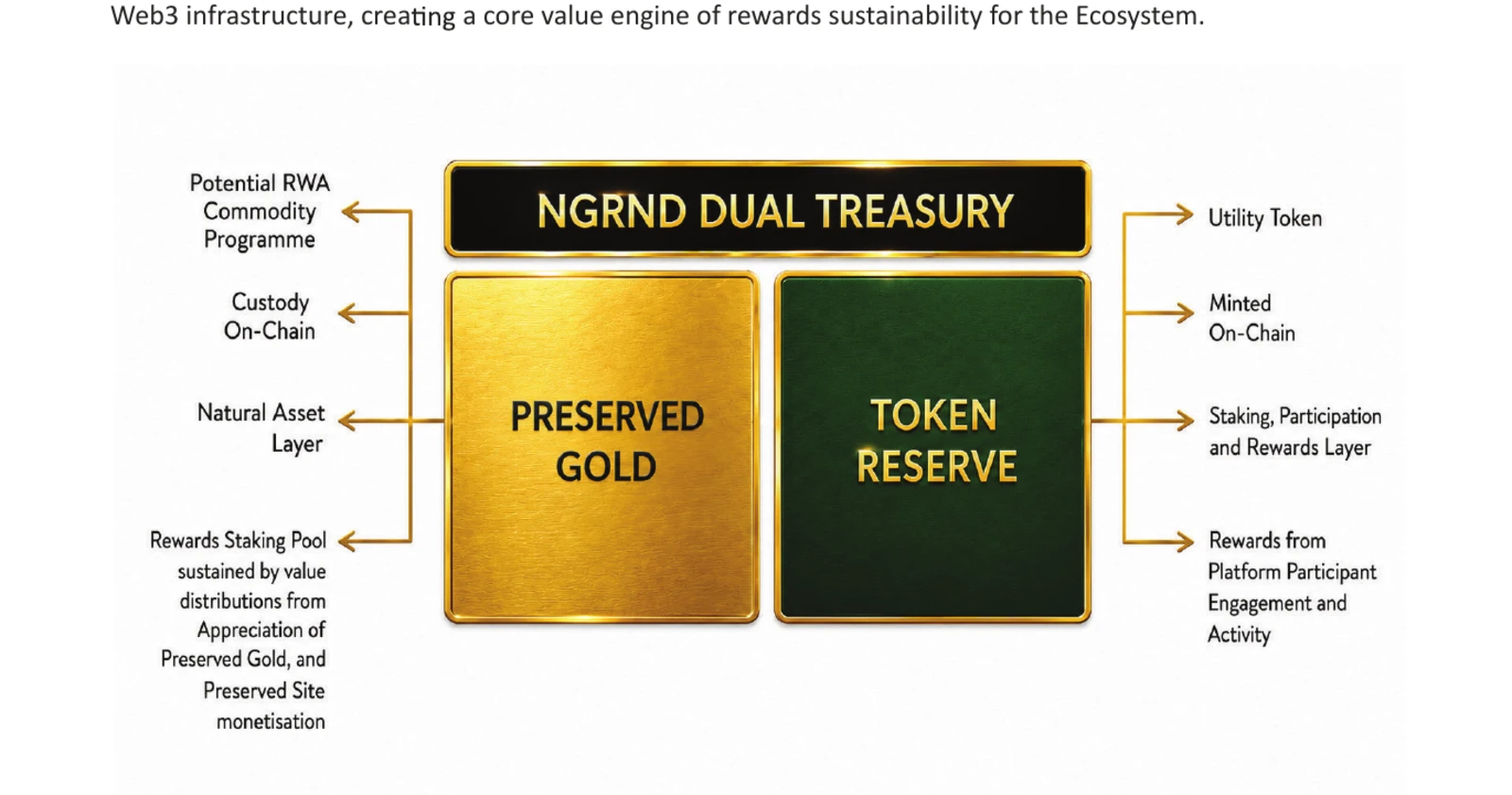
The nGRND Gold Protocol uses a Dual Treasury strategy to combine natural wealth preservation with native Web3 infrastructure, creating a core value engine of rewards sustainability for the Ecosystem.
Commodity <-- --> Utility Token Programme Custody Minted On-Chain On-Chain
Rewards Staking Pool <4 sustained by value distributions from
Appreciation of Preserved Gold, and Preserved Site monetisation
The Dual Treasury holds two components: Preserved Gold and the [NGRND] Token Reserve. Under the Protocol framework, the Ecosystem intends to sustain at least one (1) ounce of verified Preserved Gold for every 35,000 [NGRND] in circulation, linking the long-term expansion of the Ecosystem to the potential realised appreciation and growth of secured in-ground Preserved Gold.
e Preserved Gold functions as the foundational real-world natural asset layer of the Ecosystem, providing quantifiable underlying appreciative resources, enabling revenues from ESG, SDG and sustainability initiatives that sustain staking rewards pools, long-term treasury alignment, and future
opportunities for financial infrastructure or RWA tokenisation.
e The [NGRND] Token Reserve supports Ecosystem growth with Platform utilities such as staking and reward systems, community governance, participation rewards, and other Platform incentives.
Together, these mechanisms allow the nGRND Protocol to align sustainable resource preservation with
long-term Ecosystem development and treasury expansion.